Buyer's Guide · Therapists
Do Therapists Need a Website If They're on Psychology Today?
A profile gets you found by people filtering on insurance and zip code. It cannot show them what working with you is like. Here is where each one stops, and when you can skip the website.
Some therapists can skip the website. If your caseload fills from insurance panels and referrals, a Psychology Today profile plus a Google Business Profile may be all you need, and the profile costs $29.95 a month. If you are private pay, offer something specific (EMDR, telehealth, sessions in Spanish), or want clients who already understand your approach before they call, the profile runs out of room. It is a template you rent, listed beside every other therapist in your zip code, with one page for everything you do. A website is the page you own: your fees, your explanation of how the work goes, your contact form asking only what it should.
A Psychology Today profile and a website do two different jobs, and the question is whether your practice needs the second one. Two of my clients are therapists in Las Vegas. Both kept their directory listings after their sites went live, because the listing still brings the first click. What changed is what happens after that click: instead of a bio box beside forty similar bio boxes, the person lands on a site that explains the one thing they were searching for.
This article covers what the directory does well, where it stops, when a profile alone is enough, what a therapist site has to include, the contact form and tracking rules worth knowing, and what a site costs. The numbers about Psychology Today come from its own membership page, linked below.
What does a Psychology Today profile do well?
It puts you in front of people who are already looking. Psychology Today's membership page lists a fixed fee of $29.95 a month with no contract, reports about 971,000 unique users browsing the US directory each week, and claims the directory is the top Google result for therapy seekers 96.2 percent of the time. Those are the company's numbers, but the mechanism behind them is real: the site has spent two decades building pages for every city and every issue, and Google ranks it for searches a solo practice will never rank for.
The directory's filters do the matching. A person types a zip code, picks "anxiety" and their insurance plan, and gets a list. If you take that plan, you are on the list. One new client a month covers the fee many times over at any session rate, which is why the profile is the first thing most therapists buy and the last thing they cancel.
The company's own FAQ goes one step further and says that "many members find that they no longer need a website after joining." Read that as what it is: the pitch from the company selling the listing. For some practices it is true. The next section is how to tell whether yours is one of them.
What can't a directory profile do?
- You rent the page. The layout, the fields, the character limits, and the price belong to the directory. Cancel, and the page and its history are gone. The address is
psychologytoday.com/..., so when someone searches your name, the directory's page is what ranks, and the directory decides what appears on it. - You are listed beside your competition. Every profile uses the same template: headshot, short bio, checkboxes. A person comparing three therapists who treat the same issue and take the same insurance has nothing to decide on except the photo and the first two sentences.
- One page has to hold everything. A profile cannot explain how a first session goes, what EMDR over a video call looks like, how your sliding scale works, or that you offer sessions in Spanish, each in enough depth for someone to decide. The profile can list those as tags. It cannot teach them.
- The directory does not answer questions. People search for "online EMDR therapy how it works" and "therapy intake what to expect" before they ever search for a therapist. Those searches land on pages that answer them. A profile is never one of those pages.
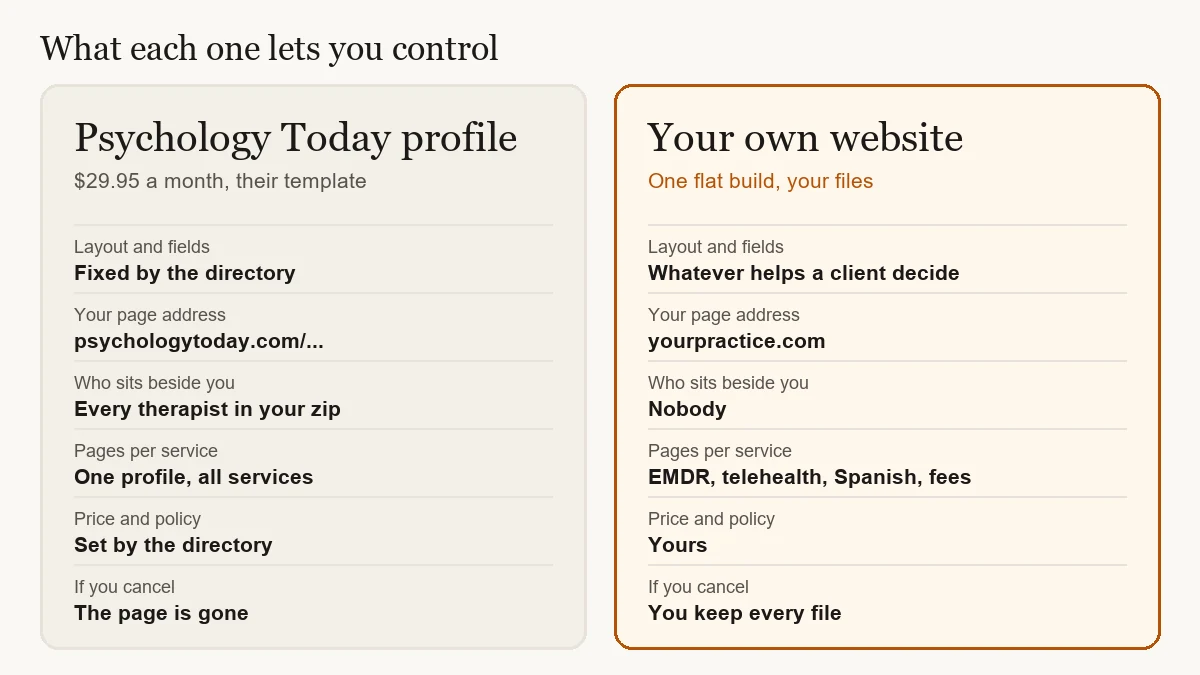
A directory shows that you exist. Your website shows what it is like to work with you.
When is a profile enough?
Skip the website, at least for now, if most of these describe you:
- Your caseload is full or close to it, and most new clients come from insurance panels or colleagues who refer to you by name.
- You work inside a group practice that already has a site with a page for you.
- You treat the common issues, with the common methods, at the standard rate, and you do not need to explain anything before the first call.
- You are not planning to grow, raise fees, or move to private pay in the next couple of years.
In that case, keep the profile current and claim a Google Business Profile so your name search shows your phone number and reviews. One caution on that second item: Google's guidelines require a location clients can visit or a service area you travel to, and a rented mailing address counts as a virtual office that is not eligible. A telehealth-only practice should read those rules before building a plan around the listing.
If you are private pay, if your method is the reason people choose you, or if you want the kind of client who has already read how you work and wants exactly that, the profile cannot carry the practice alone. You need a page you own.
What does a therapist website need that a profile can't hold?
A therapist site does not need to be large. One of my clients is a trauma therapist whose practice is fully telehealth, offering EMDR in English and Spanish. Her site has a handful of pages, and the one that earns its keep explains how EMDR works over a video call: what bilateral stimulation looks like on a screen, how the eight phases go, what the research says, and how to set up the room at home. A directory profile has a checkbox for "EMDR" and a checkbox for "Spanish." Those are the five pieces a site needs:
- One page per thing you treat or method you use. "Anxiety," "EMDR," "couples," each with its own page that says who it is for and how the work goes. These are the pages people find when they search for the issue instead of for a therapist.
- What a first session is like. Length, format, what you ask, what they do not have to say yet. Most people who want to start therapy delay because they do not know this.
- Fees and insurance, in dollars. "$150 per 50-minute session, superbills provided" answers the question that stops people from calling. Hiding the fee does not raise it.
- A short consultation path. A form that asks for a name, a way to reach you, and a preferred time. Nothing clinical. More on this in the next section.
- A Spanish-language page if you offer sessions in Spanish. A translated page is how Spanish-speaking clients find you through search. A checkbox in a directory is not.
What about HIPAA and the contact form?
I am a web designer, not a lawyer, so take this as a builder's checklist and have your compliance person confirm it. Three rules cover most of the risk.
- Collect the minimum on the form. Name, contact method, preferred time. Do not ask what brings them to therapy on a public web form. Save that for the intake you run inside your practice software.
- Know where form submissions go. They land in an inbox or a form service. If anything clinical could arrive that way, the provider should sign a business associate agreement, or the form should route into a practice system that already has one.
- Keep tracking tools off the contact and intake pages. In June 2024 a federal court vacated part of a federal health department bulletin that had treated a visitor's IP address plus a visit to a public health page as protected information, and the department later dropped its appeal. The rest of the bulletin stands, and the law firms covering the case note that lawsuits over website tracking tools have continued. The simple route is to leave analytics and advertising pixels off any page where someone tells you something about themselves.
Profile only
- $29.95 a month, for as long as you want the listing
- One template page beside every competitor
- Name search shows the directory's page about you
- Services and languages as checkboxes
- Fees as a range the directory formats
- Cancel and the page disappears
Profile plus your own site
- Profile still brings the first click
- A page you own for each issue and method
- Name search shows your site, your reviews, your number
- A Spanish page that Spanish speakers can find
- Your fees, your words, your consultation form
- One flat build, and you keep every file
What does a therapist website cost, and how long does it take?
Put the two side by side. The directory profile is $29.95 a month, about $359 a year, for as long as you keep it. A site is a one-time build plus hosting. On my pricing page, a single landing page is $1,000 and a full site is $2,100, with hosting and updates at $35 a month if you want me to handle them. Most of my builds ship in two to four weeks; my post on how long a website takes walks through the timeline. Agencies in town quote $5,000 and up for the same scope, and the DIY builders cost less up front but never stop charging. My post on what a website costs in Las Vegas has the full comparison.
Whatever you pay, make sure the domain, the hosting account, and the files are in your name. That is the difference between a site you own and a second thing you rent. If you are not sure who holds yours, three ten-minute checks will tell you.
How I build sites for therapists
Two of the reviews on my about page are from therapists, and both sites started the same way: I read their directory profile, asked what the profile could not say, and built pages for those things. The build is a flat price. You see a free preview of the whole site before you pay anything. The contact form asks for three things and nothing clinical. Every site I ship meets WCAG 2.2 AA, which matters more for a practice than for most businesses; my post on ADA compliance for small business websites explains why. When it is done, the domain, the hosting login, and the source files are yours.
If your practice offers sessions in Spanish, the Spanish page is part of the build. You can see finished sites on my work page. If your directory profile is working and you want to find out what a site would add, send me the profile link and I will tell you what I would build and what I would leave alone.
Sources and further reading
- Psychology Today · Join the directory (the $29.95 monthly fee, weekly directory users, the search-result claim, and the "no longer need a website" statement)
- Google · Guidelines for representing your business on Google (eligibility: a location customers can visit or a service area; virtual offices not eligible)
- Morrison Foerster · Federal judge vacates portions of OCR guidance on online tracking technologies (what the June 2024 ruling did and did not change)
- Morrison Foerster · HHS withdraws appeal of the tracking decision (the appeal withdrawal and the continuing lawsuits)
- Who Owns Your Website? Domain, Hosting, and Files Explained (the ownership checks that apply to any site you pay for)
- Is Your Website ADA Compliant? (why accessibility is part of every build)
Have a profile and wondering what a site would add?
Send me your Psychology Today link. I'll design a free preview of the pages your profile can't hold, and you only pay if you love it.